Yes on the SAVE Act
Secure Elections Start with Citizenship and ID
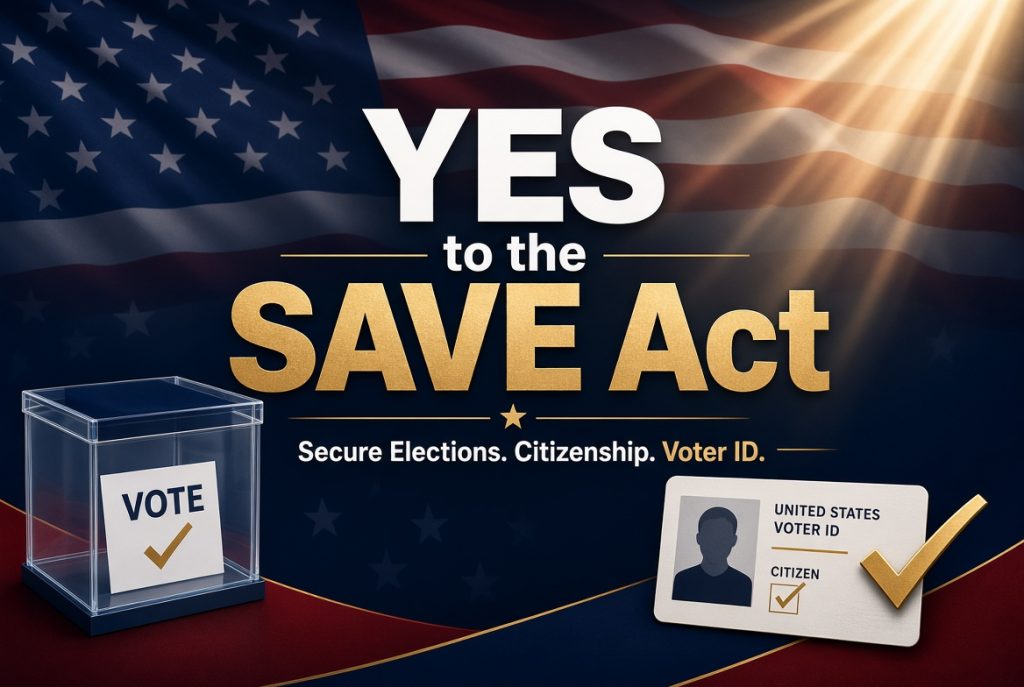
In a free country, the right to vote is sacred — and it belongs exclusively to citizens. The SAVE Act (Safeguard American Voter Eligibility Act / SAVE America Act) simply requires two basic, reasonable things:
- Documentary proof of U.S. citizenship when registering to vote
- Photo identification when casting a ballot
These are not radical ideas. They are the same standards most Americans already follow when they board a plane, buy alcohol, open a bank account, or pick up a package. Yet somehow, when it comes to the most important civic act of all — choosing our leaders — these basic safeguards are treated as controversial. They shouldn’t be.
Why the SAVE Act Matters
- Citizenship is the foundation of voting
Non-citizens are already prohibited by federal law from voting in federal elections. The SAVE Act simply enforces that existing law with real documentation instead of an honor system. - Voter ID is overwhelmingly popular
Poll after poll shows 70–80%+ of Americans — including majorities of Democrats, Independents, and Republicans — support requiring photo ID to vote. This is one of the rare issues that unites the country. - Confidence in elections is essential
When citizens believe the system is secure, participation rises and trust grows. When they doubt it, cynicism spreads. Clear rules restore faith. - It protects legal voters
Every illegal or improper ballot dilutes the voice of a lawful citizen. Securing the rolls is an act of fairness, not exclusion.
Addressing the Common Objections: “It will disenfranchise voters.”
States that have implemented strong voter ID laws have not seen significant drops in legitimate turnout. Reasonable exceptions and free ID options already exist in most places. The real disenfranchisement happens when lawful votes are canceled out by unlawful ones.
States that have implemented strong voter ID laws have not seen significant drops in legitimate turnout. Reasonable exceptions and free ID options already exist in most places. The real disenfranchisement happens when lawful votes are canceled out by unlawful ones.
“It’s unnecessary because fraud is rare.”
Even rare fraud is too much. We lock our doors not because break-ins happen every night, but because the risk is real and the cost of failure is high. Elections deserve the same seriousness.
Even rare fraud is too much. We lock our doors not because break-ins happen every night, but because the risk is real and the cost of failure is high. Elections deserve the same seriousness.
The statement “voter fraud is rare” can not be correctly stated unless we actual try to enforce it. Then show the real data. Lets follow that logic for a moment – example of avoidance of the truth. A particular person saying Crime is rare, because that person does not personally witness any, does not remove the real fact that crime is very real and happening all around them! You will not find something that you are not looking for, and some groups of people love to ignore what is right in their faces. Let us instead make into law common sense rules and then gather real data.
“States should handle this themselves.”
Many states already do — and do it well. A clear federal standard for federal elections simply ensures every American is playing by the same basic rules when choosing the President and Congress.
The Bottom Line:
The SAVE Act is not about suppressing votes.
It is about protecting the value of every legal vote.
It is about protecting the value of every legal vote.
It is not extreme.
It is the minimum standard a serious democracy should maintain.
It is the minimum standard a serious democracy should maintain.
Supporting the SAVE Act means saying:
American elections belong to American citizens.
American elections belong to American citizens.
Why the SAVE Act does not prevent married women from voting
The claim that the SAVE Act would stop married women from voting because their birth certificate shows a different (maiden) name is incorrect.
Here’s why:
- The bill explicitly requires states to create a process for people whose current legal name does not match the name on their proof-of-citizenship document (such as a birth certificate).
- Married women (and anyone else who has legally changed their name) can provide additional documentation — most commonly a marriage certificate, court order, or other official record of the name change — along with their birth certificate or passport.
- In many versions of the bill, voters also have the option to sign an affidavit attesting that the name on the citizenship document is their previous legal name.
- The goal is simply to confirm the person is a U.S. citizen. Once citizenship and identity are verified through the allowed combination of documents, the voter is registered under their current legal name and can vote normally with photo ID.
In short: Name changes due to marriage are a routine, well-known situation. The SAVE Act builds in clear procedures to handle them so that eligible citizens are not blocked from registering or voting.
Senate Majority Leader: John Thune’s Position:
Supports the policies (proof of citizenship, voter ID). Barriers are pure math:
- No 60 votes (Democrats unified against)
- No votes to eliminate the filibuster
- Sometimes short of 50 Republican votes
- Further pressure or floor time will not change the numbers without more seats or a rules change
Our Recommended – Proposed Paths – Make it into Law!
1. Eliminate (“nuke”) the filibuster
How it works: Simple majority (51 votes including VP) changes Senate rules so bills pass with 51 votes.
Addresses Thune’s math concern?: Yes – removes the 60-vote barrier.
How it works: Simple majority (51 votes including VP) changes Senate rules so bills pass with 51 votes.
Addresses Thune’s math concern?: Yes – removes the 60-vote barrier.
2. Talking filibuster (Mike Lee approach)
How it works: Keep the bill on the floor indefinitely; force Democrats to hold the floor until they exhaust or concede.
Addresses Thune’s math concern?: Tries to wear down opposition without changing rules.
How it works: Keep the bill on the floor indefinitely; force Democrats to hold the floor until they exhaust or concede.
Addresses Thune’s math concern?: Tries to wear down opposition without changing rules.
3. Budget reconciliation
How it works: Package the bill (or key parts) as having a direct budgetary impact so it needs only 51 votes and cannot be filibustered.
Addresses Thune’s math concern?: Yes – bypasses the 60-vote threshold.
How it works: Package the bill (or key parts) as having a direct budgetary impact so it needs only 51 votes and cannot be filibustered.
Addresses Thune’s math concern?: Yes – bypasses the 60-vote threshold.
4. Attach to must-pass legislation (NDAA, FISA, appropriations, etc.)
How it works: Force a single up-or-down vote by linking it to funding or defense bills.
Addresses Thune’s math concern?: Creates political pressure but still requires 60 votes or risks killing the host bill.
Practical status: Tried multiple times in 2026; failed when four RINO Republican holdouts joined Democrats.
How it works: Force a single up-or-down vote by linking it to funding or defense bills.
Addresses Thune’s math concern?: Creates political pressure but still requires 60 votes or risks killing the host bill.
Practical status: Tried multiple times in 2026; failed when four RINO Republican holdouts joined Democrats.
Bottom line:
Thune and Friends treats the current vote counts as fixed facts. The alternative paths try to circumvent those exact obstacles. So far, repeated floor failures and parliamentarian rulings have aligned more closely with Thune’s description of the “facts on the ground.”
Thune and Friends treats the current vote counts as fixed facts. The alternative paths try to circumvent those exact obstacles. So far, repeated floor failures and parliamentarian rulings have aligned more closely with Thune’s description of the “facts on the ground.”