08-26-2026
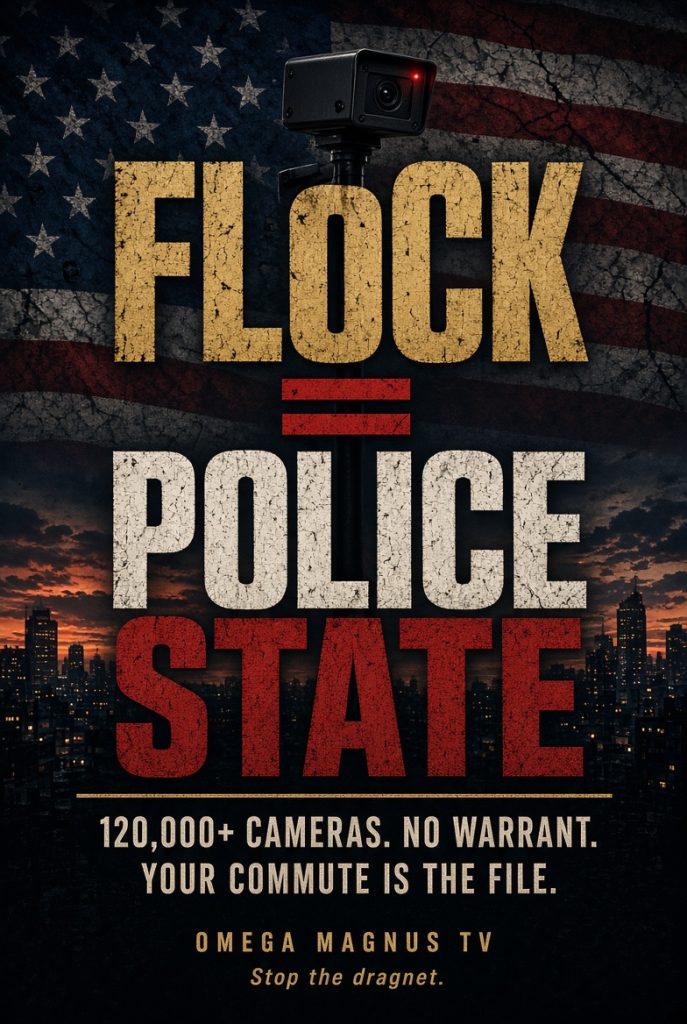
Flock Cameras
=
Police State!
YES =
Flock Cameras creates a police state against American civilians!
(Best Viewed on Tablet or PC format.)
OMEGA MAGNUS TV · POLICY BRIEF August 26, 2026
Innocent until proven guilty — not tracked until convenient.
Why a Nationwide Flock Camera Network
Builds a Police-State Architecture
A technology specialist’s brief on automated license plate readers,
innocent-until-proven-guilty, and who should be allowed to search your movements.
- 120,000+ cameras claimed by Flock (July 2026)
- 111,000+ independently mapped Flock units ~20B
- Vehicle scans per month 5,000+ law-enforcement agencies on the net
Figures compiled from Flock Safety statements (July 2026), Finding Flock / OpenStreetMap mapping (Aug. 26, 2026),
and contemporaneous reporting. Mapped counts are a floor, not a census. The argument in one paragraph:
A police state is not defined only by secret police and midnight knocks. It is defined by continuous, searchable
records of ordinary life, held by the state, queried without a warrant, shared across jurisdictions, and used to treat
proximity as suspicion.
Flock Safety’s automated license plate reader (ALPR) network does not need to photograph
your face to do that. A plate is already a durable link to a registered owner. Add make, model, color, dents, racks,
bumper stickers, time, and GPS — then stitch those sightings across 49 states — and you have a movement history of
civilians who have committed no crime. That is not “a camera on a pole.” That is a national tracking layer.
“We are not a nation of slaves managed by a few masters with a perfect map of every car.”
What the machines actually collect
Flock says its ALPRs “focus on vehicles, not people,” and do not use facial recognition. That is true as far as it goes —
and it is also incomplete statement. | Facial Recognition – does not mean it does not record people. In reality FLOCK records people inside the cars and police are using that data to hunt citizens down from the images provided.
The Rest of the Story: The system photographs passing vehicles and uses computer vision to extract a searchable
“vehicle fingerprint”: plate number and state, make, model, color, body type, direction of travel, and distinguishing
features such as bumper stickers, roof racks, and damage. Each hit is stamped with time and location. Cameras can
image vehicles at highway speed. Context photos can incidentally include occupants, pedestrians, clothing, and
political decals even when the search index is vehicle-first.
Two uses matter more than the marketing copy.
First, hotlists: plates are compared in real time against stolen-vehicle
lists, missing-person alerts, and NCIC categories — including lists populated by other agencies.
Including security risks by non-local police. (This feels like CHINA social rating in America!)
Second, retrospective (the big concern!)
Search: an officer can query a plate or a description after the fact and reconstruct where that vehicle appeared across
participating networks. When nationwide lookup is enabled, a small-town deputy can search far beyond the town that
paid for the camera.
Scale is the point — not the side effect
Flock grew from a neighborhood anti-theft pitch into infrastructure. Company statements put the network above
120,000 cameras in 49 states, serving thousands of agencies and a large private-customer layer (HOAs, businesses).
Independent maps documented more than 111,000
Flock units and more than 136,000 ALPRs of all brands by late August 2026. Reporting has described on the order of 20 billion vehicle scans per month. One analysis cited by journalists estimated that a typical registered vehicle may be scanned hundreds of times a year. Coverage is not limited to downtown cores. Cameras sit on the edge of small towns and along highways — exactly the places that log
everyone coming and going.
Recent Example:
$270,000 contract covering about 90 police-operated Flock cameras through June 2027, after public opposition and
with new guardrails: seven-day default retention, limits on nationwide sharing, and city control over federal sharing.
Guard rails after backlash are not proof the architecture is safe. They are proof the original design outran consent.
Why this matches police-state architecture
1. Mass collection first: suspicion later. Classical policing starts with a crime and looks for a suspect. A dragnet
ALPR network starts with everyone and waits for a query. That inverts presumption. Innocent-until-proven-guilty
becomes “prove you were not the similar car near the crime.” A plate match, a similar make and color, or a bumper
sticker can put an uninvolved driver into an armed response.
2. Warrantless retrospective search: There is still no U.S. Supreme Court holding that querying a dense national
ALPR network requires a warrant. Some trial and appellate courts have treated public-road plate photos as
unprotected, distinguishing them from the cell-site “mosaic” in Carpenter v. United States (2018). Other judges and
advocates argue the opposite: once cameras are dense enough and sharing is national, the database is encyclopedic
location history — the thing Carpenter said the Fourth Amendment was written to restrain. Courts have split. Officers,
in the meantime, can search first.
3. Local hands on a federal-scale tool: A tool this powerful does not stay local. Audits and reporting have
documented out-of-state and federal queries of city networks, immigration-related lookups routed through local
accounts even where cities claimed they did not partner with ICE, and “side door” searches performed as favors.
Flock’s corporate position is that it has no ICE contract and that communities control sharing. That is not the same as
“the data cannot leave town.” Local agencies can share. Local agencies have shared. Once a small department opts into
a national pool, the town council is no longer the real boundary.
4. Mission creep is already documented: Public logs have shown ALPR searches used for school residency checks,
noise complaints, and other non-felony fishing.
A system built for stolen cars becomes a general-purpose “who was here?” machine.
That is how surveillance states grow: not by announcing tyranny, but by adding one convenient use at
a time.
5. Abuse is not theoretical: Investigative reporting in 2026 documented dozens of cases in which officers used ALPR
networks to stalk intimate partners, exes, or people they wanted to watch. In Braselton, Georgia, the police chief was
charged after logs showed roughly 600 lookups of a woman and her teenage daughter. Georgia saw additional arrests
in Cherokee, Coffee, and Echols counties. A California deputy was sentenced to prison after a campaign that included
Flock queries. The Institute for Justice described officer-on-civilian tracking cases as almost certainly an undercount.
Audit logs catch some of this — after the fact, if someone looks.
The everyday nightmare this architecture makes cheap: police at your door with guns drawn because your car
“matched” a nearby robbery vehicle. A house shot up because a driver wore a similar shirt and had a similar build to a
suspect across town. You did not commit a crime. You drove past a camera. In a warrant-first system, that coincidence is
not a raid package.
In a query-first system, it can be. This tool can quickly be used against citizens by local police and security agencies that may at the time not currently agree with you or your lifestyle! It is a police state waiting to happen!
What proponents get right — and why it does not settle the question
Honesty requires the other side. Departments credit ALPRs with recovered stolen cars, homicide leads, and
missing-person finds. Some cities report drops in auto theft after deployment. Cameras on public roads photograph
what any officer standing on the curb could see, one car at a time. Flock has shortened recommended default retention
from 30 days to 7, added case-code prompts, and offered tighter sharing controls after backlash. More than 50 communities canceled, paused, or deactivated contracts in 2026; dozens more have done so since 2025.
Those are real public-safety claims and real political pushback.
None of that answers the structural question. A tool can catch thieves and still be the wrong architecture for a free
country if it gives every participating agency a searchable history of the innocent.
Crime-solving is not a blank check!
The rule that should replace the dragnet
Powerful tools need tight limits — specific target, active case, higher-level authorization, real audit, and real
punishment for abuse. A workable civil-liberty rule looks like this:
- Local cameras, local cases. A town may run readers for its own hotlist hits and its own active investigations. That is
a far cry from a national movement graph. - • Interstate and nationwide lookup: federal only, and only for a particular plate or vehicle already under an
active investigation — not to go fishing and create an investigation. - • No warrantless mosaic. Reconstructing a person’s travel across jurisdictions should require a judge, probable cause,
and a case number that is real — not a box an officer can type anything into. - • Short retention, no silent federal pipe. Seven days should be a ceiling for unmatched traffic, not a marketing
default cities can quietly extend. Sharing with federal agencies should be off unless a warrant, subpoena, or a recorded,
lawful request from the city that owns the data says otherwise. - • Public audit, not self-audit. Search logs should be reviewable by elected officials and, with privacy redactions, by
the public. Agencies that never look will never find the stalking cases.
Positive Locations for FLOCK Cameras:
- Jails and Courts
- State and Federal Government Buildings
- Police Stations
- Federal Law Enforcement Buildings
- Military Installations
- Energy Installations
- Water & Waste Management Installations
- Bio-Labs / Bio-Weapon Testing Installations
- Congress parking areas
- Planned Parenthood (maybe)
Closing
I sell cybersecurity and physical security. I have worked in this field since 1999. I am not opposed to cameras,
investigations, or catching people who steal cars and kill people. I am opposed to handing local government a national
tracking layer and calling it “public safety.” Too much power, not enough control, and a technology that treats every
commute as potential evidence against you.
Innocent until proven guilty is lost the moment the state can replay your week and ask you to explain it. That is the
line crossed by Flock’s network, as deployed and shared today, and it is crossing it!
— Glenn, Omega Magnus TV · August 26, 2026 · X@OmegaMagnusTV